TLDR
For a small craft business testing a design or ordering a tiny batch, CustomStickers has the clearest documented advantage: it lists no-minimum die-cut stickers, including the option to order a single sticker, plus small sticker-sheet quantities. Sticker Mule becomes more competitive when you need a standard production run and its final checkout price or delivery date works better for your exact configuration. Do not compare headline starting prices. Build the same product at both vendors, review the proofs carefully, and compare the delivered totals.
The useful answer to the CustomStickers vs Sticker Mule craft business question depends on what you are making. A glossy logo sticker for outgoing parcels, a five-design retail sheet, and a roll of jar labels are three different production jobs. Match the format, size, quantity, finish, deadline, and proof workflow before choosing a printer.
My practical recommendation is to start with professionally printed stickers and labels from CustomStickers when you need one-off prototypes, low-quantity die cuts, or a small sticker-sheet experiment. Also quote Sticker Mule for established designs and larger runs. The winning vendor is the one that gives your exact job the right format, acceptable proof, manageable delivered cost, and workable arrival date—not necessarily the lowest price printed on a product landing page.
CustomStickers vs Sticker Mule craft business comparison
| Decision factor | CustomStickers | Sticker Mule | Why it matters |
|---|---|---|---|
| Small die-cut orders | Lists a no-minimum die-cut product and permits an order of one sticker. | Its sample program starts at 10 stickers per design. | A one-piece order is useful for checking dimensions before committing to packaging or retail stock. |
| Standard sticker material | Describes standard custom stickers as white vinyl with laminate, with matte and gloss finishes. | Describes custom stickers as thick premium vinyl with protective laminate; its standard die-cut description identifies a matte finish. | Finish affects glare, color appearance, photography, and how the sticker coordinates with your packaging. |
| Sticker sheets | Lists 6×4, 7×5, and 11×8.5-inch white-vinyl sheets with kiss cuts and matte or gloss options. | Lists 4×6, 8.5×11, and custom sheets and permits a ZIP of individual designs for layout. | Sheet dimensions determine how many designs fit and whether the finished product suits retail display or envelope packaging. |
| Proof workflow | Says proofs are optional, revisions are unlimited, and an unreviewed proof auto-approves after three days. Verify that timing when ordering. | Says it provides online proofs, accepts requested changes, and charges the card after proof approval. | Proofing is your best chance to catch an incorrect border, scale, cut path, or spelling error. |
| Stated timing | Lists typical processing of 2–4 business days and notes that proofs or revisions can add time. Its next-day option has eligibility restrictions. | States a standard U.S. schedule of four business days for production plus two-day shipping, with paid rush production on some qualifying orders. | Production time is not the same as the delivery date. Enter the destination ZIP and compare checkout estimates. |
| Labels | Sells roll labels as well as stickers. | Distinguishes thinner BOPP labels intended for production use from its thicker vinyl stickers. | Labels are generally the more practical format for repeatedly sealing mailers or labeling jars, bottles, and boxes. |
| Shipping | States that U.S. economy shipping is free above $35. | States that custom sticker orders ship free. | Compare delivered totals, not product subtotals. Faster shipping and taxes can change the result. |
| Returns and production problems | States that made-to-order products are not eligible for change-of-mind returns but identifies certain production, packing, shipping, or transit problems as replacement-eligible. | States that custom orders cannot be returned for non-quality reasons such as choosing the wrong size or changing your mind. | Measure carefully and approve the proof as if the order cannot be casually returned—because custom printing usually cannot be. |
This table deliberately avoids declaring a print-quality winner. No comparable hands-on orders were supplied for this evaluation, so there is no responsible basis for saying one vendor produced better color, smoother cuts, stronger adhesion, easier peeling, or safer packaging. Those judgments require matching samples and documented test conditions.
Choose the product before choosing the printer
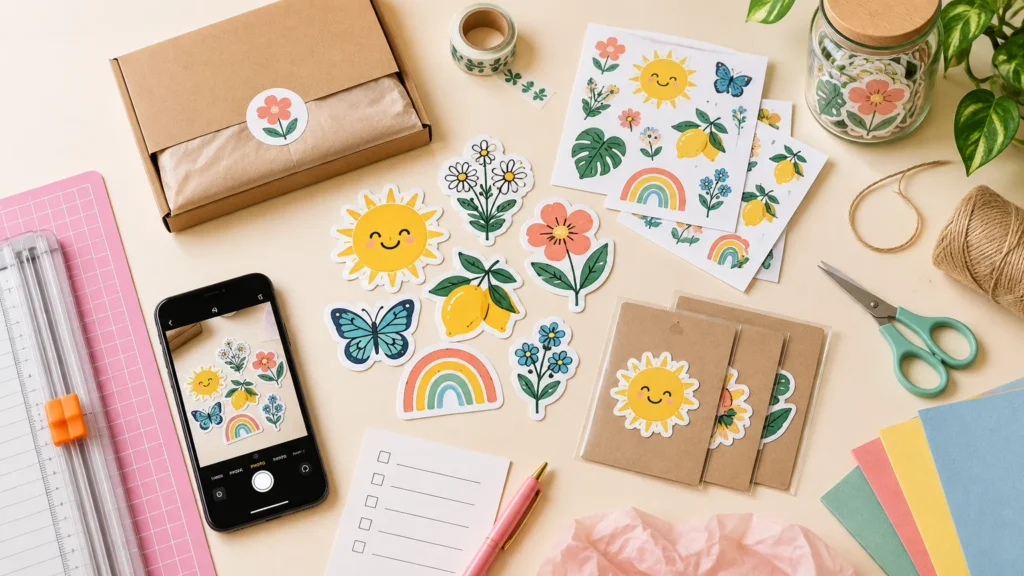
The biggest comparison mistake is putting unlike products in the same race. Thick individual stickers are great as gifts, retail pieces, laptop decals, and package inserts. Roll labels are usually better when you need to peel and apply hundreds of identical seals efficiently. Sticker sheets can become the product itself, especially when several coordinating designs tell a tiny visual story.
For market freebies and package inserts
Quote an individual die-cut sticker in the exact finished size you plan to give away. Small quantity flexibility makes CustomStickers appealing while the design is experimental. Once the artwork is proven, quote a larger identical run from both vendors. Keep the shape, dimensions, quantity, material, and shipping speed consistent.
If the sticker is a free extra rather than a product, control its cost as part of your packaging budget. A beautiful three-inch sticker may delight customers, but a smaller logo mark could serve the same purpose without crowding a thank-you card or raising the cost of every parcel.
For retail sticker sheets
CustomStickers offers several listed sheet sizes and a low entry point for experimentation, while Sticker Mule offers standard and custom sheet formats. Start by drawing the outer sheet rectangle at actual size. Arrange your designs with comfortable space between cut lines, then reserve room for a shop name, collection title, or small backing-card message.
Think beyond how many illustrations technically fit. Tiny kiss-cut pieces can be awkward to peel, and a crowded layout can feel less polished than four or five generously spaced designs. If sticker sheets will become a regular product, document the final dimensions, finish, export settings, and approved proof alongside your other repeatable processes. The same discipline helps when you build a sticker catalog for an Etsy shop.
For jars, mailers, bottles, and product seals
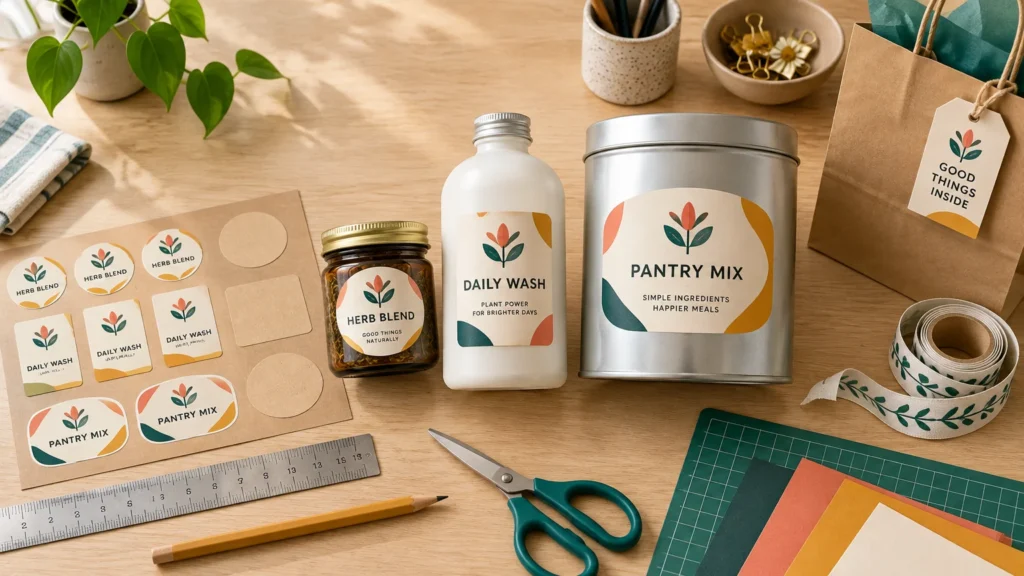
Start in the label category rather than automatically ordering individual stickers. Sticker Mule describes labels as thinner BOPP products intended for faster peeling and production applications, while CustomStickers also offers roll labels. The correct choice depends on the container, application speed, exposure to moisture, and whether the label must wrap around a curve.
Measure the actual package rather than relying on a supplier’s nominal container size. Print a paper rectangle at 100 percent scale, trim it, and tape it to the jar or mailer. Check the curve, seams, lid clearance, and readable type before ordering. For a deeper setup process, use this guide to design product labels that remain readable on the package.
Use a like-for-like quote basket
Prices and promotions can change, and a low starting price may refer to a different size or quantity than the product you need. Open both vendors on the same day and build equivalent baskets. If one vendor lacks an exact match, note the difference instead of quietly treating the products as equal.
A useful craft-business quote basket contains four jobs:
- One hundred custom-shaped vinyl die cuts at three inches, using the closest equivalent finish.
- Five hundred 2×2-inch packaging labels, with the same shape and comparable label material.
- Fifty sticker sheets around 4×6 inches, each containing the same five kiss-cut designs.
- The smallest practical prototype order for one die-cut design.
For each basket, record the product name, finished dimensions, quantity, material, finish, proof choice, production speed, shipping service, discount, tax, delivered total, and estimated delivery date. Divide the delivered total by the number of usable pieces or sheets to find the effective unit cost. Keep setup samples separate from production inventory when calculating margins.
The prototype line is especially revealing. CustomStickers documents the ability to order one no-minimum die-cut sticker, whereas Sticker Mule’s sample offering begins at 10 pieces per design. Ten samples may be welcome if you want to photograph, package, and share a design. One may be enough when you are checking whether a two-inch sticker actually fits a small box.
Treat the proof as a production checkpoint
A proof should not receive a two-second glance because the design looked fine on your artboard. Zoom in for cut-path inspection, then view it at actual finished size. A graceful script logo on a large monitor can become a fuzzy thread when printed on a tiny seal.
Check these details before approval:
- Finished dimensions, including whether the listed size describes the artwork or the complete cut piece.
- Spelling, prices, web addresses, social handles, and required product information.
- Small text at actual printed size rather than only while zoomed in.
- White borders around every edge, especially narrow points, loops, and gaps inside letters.
- Cut paths around delicate leaves, stars, handles, or other shapes that could produce fragile projections.
- Pale colors and low-contrast type that may be difficult to read away from a bright screen.
- The position of every kiss cut on a multi-design sticker sheet.
- The approved finish and quantity, not just the artwork preview.
CustomStickers says optional proofs that remain unreviewed auto-approve after three days, so verify the live policy and put a reminder on your calendar if you request one. Sticker Mule says changes can be requested through its proof process before approval. Either way, proof revisions add decision time and may affect the delivery schedule.
Prepare artwork that survives trimming
Use vector artwork when possible, particularly for logos, lettering, and geometric borders. If you are supplying raster art, export it at a resolution appropriate for the final physical dimensions. Enlarging a small web graphic inside an upload tool does not create missing detail.
Extend background colors and illustrations beyond the intended trim edge. Adobe’s explanation of printer bleeds in Illustrator describes bleed as artwork extending beyond the trim or crop area so color reaches the finished edge after trimming. This extra image area accommodates normal cutting variation and helps prevent accidental white slivers.
Bleed is not the same as a safety margin. Bleed extends backgrounds outward; the safety margin keeps text and essential artwork inward. Avoid placing a delicate border directly against the cut path unless slight visual variation is acceptable. Centered borders make even small shifts obvious.
If you are deciding whether to outsource or produce a short run at home, compare the labor and repeatability as well as the invoice. This 100-piece Cricut versus professional sticker comparison walks through that separate decision. Cricut says Print Then Cut adds bleed by default and recommends retaining it for more accurate edge-to-edge cuts.
Account for turnaround without guessing
CustomStickers lists typical processing of 2–4 business days, while Sticker Mule describes its standard U.S. timing as four business days of production plus two-day shipping. These are planning references, not guaranteed arrival dates for every basket. Proof revisions, order eligibility, weekends, destination, and selected shipping service can change the schedule.
If an event or product launch cannot move, work backward from the date when the stickers must be in your hands—not the date of the market. Add time to inspect the shipment and recover from a production or transit problem. A nominally faster option is not useful if its estimated arrival leaves no buffer.
CustomStickers describes a restricted next-day option for qualifying orders of up to 1,000 stickers submitted before noon MDT without a proof; sticker sheets and international orders are excluded. Sticker Mule says paid three-day rush production may appear for qualifying orders under $500. Confirm eligibility in the live cart because your product, proof choice, order value, and destination all matter.
A simple final selection checklist
- Choose CustomStickers first for a one-piece prototype, very small die-cut run, or low-quantity sticker-sheet experiment.
- Quote both vendors for an established design ordered in production quantities.
- Use the label category for repeated packaging application; do not compare a thin roll label with a thick giftable sticker as though they are identical.
- Match shape, finished size, quantity, material, finish, proof choice, destination ZIP, and shipping speed.
- Compare delivered totals and estimated arrival dates on the same day.
- Review the proof at actual printed size and inspect every cut path.
- Order a sample before a large run when an exact color, tiny type, or package fit is critical.
- Save the approved proof, invoice, dimensions, and export file so the order can be reproduced.
The practical recommendation
For most new craft sellers, I would begin with CustomStickers when the immediate goal is to test one design, order only a few die cuts, or build a small sticker-sheet experiment. Its documented no-minimum option reduces the amount of unproven inventory you need to buy. That is valuable when you are still adjusting scale, borders, packaging, or product photography.
I would put Sticker Mule into the final quote round once the design is settled or when its sample quantity, sheet format, checkout total, and delivery estimate suit the job. Its free-shipping statement and proof workflow may simplify some orders, but only the complete matched basket reveals whether it is the stronger choice.
Your next step is simple: choose one real product, measure where it will go, export production-ready artwork, and enter the same configuration at both vendors. Then pick the acceptable proof with the best combination of delivered unit cost and arrival date. That project-first approach is much more reliable than trying to name one universal sticker-printing winner.
References
- Die Cut Stickers | Custom Waterproof Stickers – CustomStickers.com
- Can I see samples before I buy? | Sticker Mule
- Custom Vinyl Stickers | Waterproof and Durable – CustomStickers.com
- Custom stickers | Free shipping | Sticker Mule
- Sticker Sheets | Custom Water Proof Kiss Cut Stickers – CustomStickers.com
- Sticker Sheets – Free shipping | Sticker Mule
- Shipping Policy – CustomStickers.com
- What is your turnaround time? | Sticker Mule
- Custom Stickers | Fast & Free Shipping – CustomStickers.com
- Custom labels | Waterproof roll and sheet labels | Sticker Mule
- www.stickermule.com
- How to add printer’s marks and bleeds in Illustrator | Illustrator
- How to Print Then Cut in Design Space – Help Center